


 Free Newsletter

Rental rebound
It’s getting costlier to live in an apartment in Charlotte, much to the disappointment of renters. But the multifamily industry claims that even with the hikes, rates are only now returning to prerecession levels.
Tara Ramsey, staff writer//February 2, 2012//
Rental rebound
It’s getting costlier to live in an apartment in Charlotte, much to the disappointment of renters. But the multifamily industry claims that even with the hikes, rates are only now returning to prerecession levels.
Tara Ramsey, staff writer//February 2, 2012//


 Listen to this article
In Charlotte, apartment occupancy rates are at a record high – nearly 93 percent – and, last year alone, roughly 5,000 units were filled.
In the past year, rents increased 5 percent at apartment complexes that have been operating for more than 12 months.
 All of that is according to Scott Wilkerson, principal and chief operating officer of Charlotte-based Ginkgo Residential, who shared those stats during a Greater Charlotte Apartment Association forum Jan. 26.
But even though it’s getting more expensive to live in an apartment, industry officials say Charlotte-area rents are only now returning to where they were in 2007, just before the Great Recession came along.
“The perception is that apartments are booming and rents are the highest they’ve ever been,” said Marcie Williams, senior director of real estate for Charleston, S.C.-based Greystar, which manages 53 multifamily properties in the Carolinas. “But, really, we’re finally just being able to recover.”
And even though rents are rising in the area, they are still lower, on average, than they were seven years before the recession began, Wilkerson said. In the Charlotte metro area, multifamily residents are paying, on average, 22 percent – or $171 – less than they did in 2001.
Wilkerson did not give the current average rent in the Charlotte area.
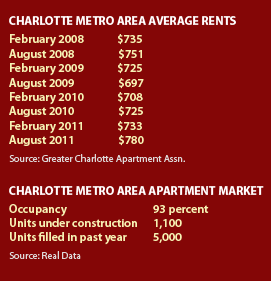 But according to a September report from Charlotte-based multifamily research firm Real Data, the average rate for an apartment in Charlotte is $780 a month. It’s the latest report available from the firm.
That was up from March, when the average rent in Charlotte was $733.
Wilkerson calls the rents that are being charged in the metro area “recovering rents.” In other words, apartment owners are still recovering from the slashed rents and specials they offered during the recession, he said.
Williams agreed. She said the multifamily market needs to recover the revenue it lost when it lowered rents before the recession.
In 2001, Williams said, she worked in an Uptown Charlotte apartment community for Summit Properties, a real estate investment trust that develops, buys and operates luxury apartment communities. After the terrorist attacks of Sept. 11, she said, people lost their jobs and the apartment community lowered its rents in response.
Williams did not name the apartment complex.
In Charlotte, Greystar manages 17 multifamily communities, including Cielo and The Retreat at McAlpine Creek.
Apartment owners were still trying to recovery from the economic downturn of 2001 when the recession struck Charlotte in 2007, she said.
Since February 2008, when the average rent in Charlotte was $735, there had been very little change in rent until late 2011, according to Ken Szymanski, executive director of the Greater Charlotte Apartment Association. Six months later, the average monthly rent in Charlotte rent was $751 and then – in six-month intervals – it went from $725 to $697 to $708 to $725 and then to $733, he said.
Williams said renters should expect their rents to rise if they are under a lease agreement, especially if they did not have any rent hikes during the past three or four years.
Wilkerson said rents in Charlotte have been flat over the past four to five years, despite the fluctuations during that time.
Properties that gave away a month of free rent to lure tenants lost 8 percent income from each of those units, he said. Some multifamily complexes have given away as much as three months in rent, for a 24 percent loss in income on those units, Williams said.
To offset housing costs in the economic downturn, many people have been living together, which further cuts down on potential rental income, Williams said.
The free rent. Multiple people cramming into units to save money. All those factors have led some apartment complex owners putting off major upgrades, industry officials say.
“They might say, ‘I hope that roof lasts another year,’” Szymanski said.
Williams agreed, saying that while the downturn likely didn’t stop apartment complex owners from making basic repairs, it might have prevented capital improvements, such as paving parking lots and repainting the exterior of buildings.
As the popularity of rentals shows no signs of letting up, Greystar, for one, is increasing its rents, Williams said.
“But they’re still not back up to the rates they once were (before the recession),” she added.
Szymanski said the decision to raise rents would not be an easy one for many apartment owners to make, even though the rental business is doing well.
“I think the owners will be a little bit conflicted,” he said. “They love to retain residents, but they have a duty to increase rents to the extent the market will bear.”
And Wilkerson warns that in a city where affordable housing is an important issue, city leaders might not take too kindly to rising rents.
“We need to be careful of a political pushback,” he said. “As an industry, we are trying to get ready for that.”
With all the home foreclosures out there, Williams said she isn’t worried that increasing rents might chase away residents and make them seek homeownership.
“The amount of foreclosures does affect us,” she said. “People aren’t dying to go out and buy a house. There’s no rush anymore.”
Renters of Class A apartments – which means the newer, fancier complexes – can afford a mortgage payment, based on the amount they are paying in rent, she said, adding that they are just being renters by choice.
Williams points to reports that Greystar and other property management companies compile when tenants move out of an apartment.
“It was always, ‘I bought a house’ or ‘I bought a condo,’” she said. “Now it’s, ‘I moved back in with my parents or got a job transfer.’”
RAMSEY can be reached at [email protected].
Related Content

Latest News
- Construction Spending Rises 0.9 Percent Annually In April; Association Urges Officials To Renew Highway And Transit Funding By September
- Zombie foreclosures rise in most states with North Carolina up 67 percent
- US consumer inflation breaks above 4% as Iran war raises energy prices
- Rail Trail Bridge to Connect Uptown to South End over I-277 work begins
- Construction employment rises in 32 states and D.C. with North Carolina adding 13,600 jobs
- ATTOM reports home purchase loans at 12-year low amid rising mortgage rates
- NCDOT unveils six design concepts to reconnect I-77 South corridor in Charlotte
- ATTOM report finds home prices grew in nearly half of opportunity zones
- Foundry Commercial Brings Uptown Charlotte Site to Market
- Construction Employment Rises By 9,000 In April As Nonresidential Hiring Offsets Residential Declines And Average Hourly Pay Rises To $38.73
- Foreclosure activity rises 18 percent annually with Delaware and South Carolina hardest hit
- Homeowners face plumbing and radon as top repair stressors across states
Features
- Thomas & Hutton Announces Ryo Yamamoto’s Professional Engineer Licensure in North Carolina
- Thomas & Hutton Grows Charlotte Team With Two New Project Engineers
- City of Charlotte Introduces New Deputy City Manager and New Director of Housing & Neighborhood Services
- JLL strengthens Charlotte capabilities with top Agency Leasing team hire from Foundry Commercial
- Thomas & Hutton Grows Charlotte Team With Two New Team Members
- Nick Schirato Joins Thomas & Hutton As An Environmental Designer In Charlotte
- Foundry Taps Alex Olofson to Lead Capital Markets Growth in Charlotte
- Tony Lathrop Strengthens Parker Poe’s Infrastructure, Transportation & Public Policy Services
- MVA Expands Economic Development & Incentives Group, Appoints Beth Buckner as Head
- Thomas & Hutton Announces Kaylee Neal’s Professional Engineer Licensure In North Carolina
- Thomas & Hutton Announces Sixth-Generation Leadership Transition as Firm Enters 80th Year
- Movement Mortgage welcomes Justin Caplan as East Coast Growth Director
Polls
 Loading ...