


 Free Newsletter

Pickleball Is Reshaping Real Estate: From “Picklemalls” to the Tennis vs. Pickleball Amenity Debate
Staff Report//February 19, 2026//
Pickleball Is Reshaping Real Estate: From “Picklemalls” to the Tennis vs. Pickleball Amenity Debate
Staff Report//February 19, 2026//


I had some unexpected extra time recently thanks to winter storm closures. Since my pickleball playtimes got canceled, I went down a rabbit hole instead. It got me thinking: pickleball is not just booming as a sport. It is reshaping real estate in some pretty fascinating ways.

Right now, I keep seeing pickleball show up in two very different real estate stories:
- Commercial real estate: pickleball as a smart adaptive reuse play that helps refill big, hard-to-lease spaces.
- Residential real estate: pickleball as a lighthearted (but real) amenity conversation about court space, scheduling, and upgrades. When communities handle it well, it can stay positive for everyone.
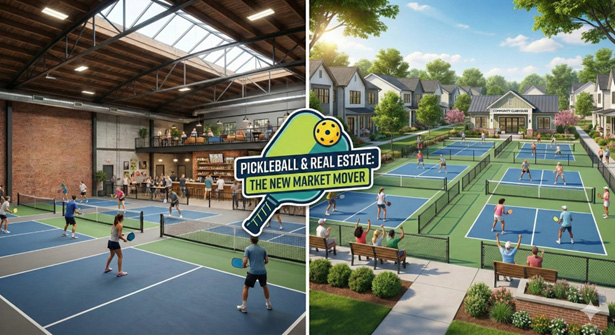
Commercial Real Estate: The Rise of “Picklemalls”
There is a reason pickleball keeps popping up in commercial real estate conversations: it fits spaces that have been tough to backfill. In September 2023, the National Association of REALTORS® highlighted the growing trend of converting empty big-box stores and vacant mall anchor spaces into indoor pickleball facilities.
Pickleball works well in large retail spaces that can be difficult to lease, and it creates reliable repeat traffic through leagues, clinics, lessons, and open play. It also benefits nearby businesses because players often grab food or drinks before or after a session.
I see that last one firsthand. After we play, my pickleball pals and I often go out for dinner. It is part of the routine, and that steady before-and-after traffic is exactly what surrounding businesses love.
Two Carolinas Proof Points: Charlotte and Fort Mill
If you want examples that make this trend feel real and local, here are two that show how different models can work.
Charlotte: Tipsy Pickle at Camp North End
In Charlotte, Tipsy Pickle held its grand opening at Camp North End on Feb. 22, 2025. It blends pickleball with a broader hangout vibe that includes food, drinks, and games.
From a real estate perspective, that matters because Camp North End is a mixed-use district. When you have something people return to again and again, it helps keep energy up for surrounding retail, events, and workplace activity.
Fort Mill: Peachtree Pickleball Near Kingsley Town Center
Fort Mill just added a strong big-box reuse example of its own: Peachtree Pickleball, now open in a 42,000-square-foot indoor facility with 10 courts. It is also a nice reuse story, since the facility is part of a former Winn-Dixie shopping center that is finding new life. What makes this one especially relevant is the location. Peachtree Plaza sits directly across from Kingsley Town Center, which already draws steady traffic for offices, restaurants, and shopping.That kind of proximity supports the same “play, then go out” routine a lot of us fall into, and it helps a place like this stay busy beyond just weekends. It also makes pickleball easier to fit into a normal day, not just a special trip.
Residential Real Estate: The Amenity Debate (Friendly Edition)
On the residential side, pickleball shows up as a resource conversation inside neighborhoods. It can actually be fun when communities handle it well.
Because the real question usually is not tennis versus pickleball. It is more like:
- Court space: shared lines, one conversion, or dedicated courts
- Court time: reservations, open play windows, league nights, peak-hour fairness
- Amenity budgets: resurfacing, lighting, fencing, and long-term maintenance
The best HOAs do not frame this as winners and losers. They treat it like a community upgrade conversation. The goal is to increase participation and enjoyment for the most residents without creating frustration.
What This Means for Buyers and Sellers
If you’re buying in an amenity community:
Ask the lifestyle due diligence questions:
- How are courts scheduled today?
- Are there any planned improvements or proposals?
- What is the culture: casual and social, competitive, or a mix?
If you’re selling in an amenity community:
Lead with lifestyle without picking sides:
- Active community amenities
- Strong social calendar
- Resort-style living
- Minutes to courts and clubhouse
Bottom line
Pickleball is not just a sport trend. It is a real estate signal. In commercial, it is helping repurpose big, hard-to-lease space into something people actually use. In residential, it is shaping how neighborhoods invest in amenities and community, ideally in a way that helps everyone play more.
Jody Christensen is a Realtor® with Keller Williams Realty Ballantyne Area, licensed in North Carolina and South Carolina. Known for blending community-building with smart real estate strategy, she helps homeowners and downsizers navigate their next move with clarity and confidence. When she’s not working with clients, you’ll likely find her on the pickleball court or bringing neighbors together through local play and events. You can contact Jody at [email protected] or 704-707-6016.
Related Content
Latest News
- Omakase Experience by PrimeFish Reveals Renovation Plans
- Mecklenburg County tried to recover homeowners’ damages in a building code dispute. The NC Court of Appeals said no
- Home flipping profit margins rise after seven quarters of decline
- CP Group reports nearly 25,000 SF leasing at Harris Corners in Charlotte
- Foreclosure filings dip month-over-month as annual trend rises nationwide
- Construction Employment Increases By 17,000 In May As Both Nonresidential And Residential Firms Add Jobs; Hourly Pay Rises By 5.0 Percent For The Year
- Construction Jobs Increase In Majority Of Metro Areas From April 2025 To April 2026 Amid Growing Data Center Pushback And Need For Highway Bill
- Unemployment and foreclosure rates drive housing market risk in Florida and California
- Wall Street loses ground slightly after first Fed statement under Warsh
- Construction Spending Rises 0.9 Percent Annually In April; Association Urges Officials To Renew Highway And Transit Funding By September
- Zombie foreclosures rise in most states with North Carolina up 67 percent
- US consumer inflation breaks above 4% as Iran war raises energy prices
Features
- CBRE Adds Veteran Office and Healthcare Leasing Professional Grant Keyes to Charlotte Team
- Thomas & Hutton Announces Ryo Yamamoto’s Professional Engineer Licensure in North Carolina
- Thomas & Hutton Grows Charlotte Team With Two New Project Engineers
- City of Charlotte Introduces New Deputy City Manager and New Director of Housing & Neighborhood Services
- JLL strengthens Charlotte capabilities with top Agency Leasing team hire from Foundry Commercial
- Thomas & Hutton Grows Charlotte Team With Two New Team Members
- Nick Schirato Joins Thomas & Hutton As An Environmental Designer In Charlotte
- Foundry Taps Alex Olofson to Lead Capital Markets Growth in Charlotte
- Tony Lathrop Strengthens Parker Poe’s Infrastructure, Transportation & Public Policy Services
- MVA Expands Economic Development & Incentives Group, Appoints Beth Buckner as Head
- Thomas & Hutton Announces Kaylee Neal’s Professional Engineer Licensure In North Carolina
- Thomas & Hutton Announces Sixth-Generation Leadership Transition as Firm Enters 80th Year
Polls
 Loading ...