


 Free Newsletter

ON THE LEVEL: Frank Warren: Betting on a big move
Eric Dinkins//April 20, 2015//


 Listen to this article
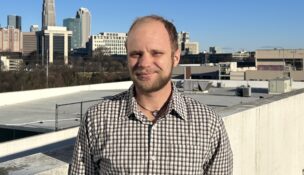
After spending almost his entire professional life as a consultant and market data researcher, Charlotte real estate veteran Frank Warren recently decided it was time to take his career in a new direction.
Since earning his master’s degree in city and regional planning from the Georgia Institute of Technology in 1987, Warren has mostly lived in Charlotte, which is also his hometown. He has worked for Faison Enterprises Inc. and Karnes Research Co., and eventually started his own consultant firm, Warren & Associates, in 2001.
Warren recently spent nearly three years at Kimley-Horn and Associates Inc., but left about a month ago to join Pennsylvania-based Vision Development as a multifamily developer. Vision focuses on housing for students and active adults, and Warren’s first project is the redevelopment of a seven-story, 190,000-square-foot former mill in Worcester, Massachusetts. The mill is being converted into housing for students who attend surrounding colleges and universities.
In his free time, Warren enjoys going to the gym, reading and spending time outdoors camping, hiking and biking; he said he lives in “a world of two extremes.” Right now he’s reading “Playing for Pizza” by John Grisham.
Last week, Warren sat down with The Mecklenburg Times to talk about how he got to where he is and why he chose to veer off the path of least resistance, and to share some of his analytic expertise about Charlotte’s commercial real estate market.
How did you get into the business? So I went to graduate school in city planning, and I had no idea where that would lead me, except I thought I would be some kind of city planner, because in those days, that’s what most people did when they came out of planning school. A few people went into real estate and other fields, or if you had an engineering background you might be an engineer. So I went to city planning school, and …interesting story…I had a professor there (who) one day during my first year – he was actually my advisor and the one who was over my research assistantship – but he called on me to stay after class, and he had already questioned some of the comments I made in class, and so when he did that, my assumption was that I had done something wrong again. But in reality he was telling me that a friend of his needed help part time with her business she had just started doing market research in real estate, and that he thought I would be a strong candidate and I should go talk to her. And I said, “Well … I have an assistantship with you, which precludes me from taking any part-time job.” And he said, “Exactly, so we did not have this conversation.” So I went and talked to her and – undercover – I had a part-time job for the remainder of my first year, and then the second year it was allowed, so most people had a part-time job. And so that is how I really got into the business of real estate, was through that internship/part-time job with a woman who had opened (the first East Coast) Robert Charles Lesser & Co. LLC office in Atlanta, and then went out on her own, and I was her first hire. I literally worked in her basement for the better part of two years. So I really started out in this business with her doing spreadsheets, surveying subdivisions, shopping subdivisions – we focused on residential which is kind of funny because that’s circling back to what I’m doing now with my development (position). That really took my city planning to more of a real estate-sector type of position.
What made you want to move into a more development-focused role?
It has been an idea to get into more direct development work for a while. It’s just been an idea, like when I’ve been in meetings with people and I’m presenting findings and trying to figure out how to make a project work, I’m thinking to myself, “I could do that. I could pull this together, and I could make this project work, maybe even better than they can.” I will say that spark has been there for a while. But at the same time, I had a successful consulting career and didn’t necessarily feel comfortable pursuing that and wondering if someone would invest in me as I would invest in them. Ironically, last fall an existing client, (Vision Development LLC President) Rick Schaffer, in a meeting, a conversation between the two of us just evolved into his small shop and him really not having capacity in-house to really get a lot of things done, and said he sure could use some help with that. So I thought about that, and then emailed him a couple days later and said, “I might have an interest in being that person for you,” and he immediately emailed me back and said, “Exactly, that would be great.”
How was the transition?
That’s an interesting question on a few levels. One is, (I’m) back to an entrepreneurial-type position, which is where I think I perform best. I’m now in a developer role, which is new for me because it’s all-encompassing in projects. Whereas before I was kind of a finite piece of the puzzle, now I’m putting the puzzle together. And I have a national scope now, in terms of where I could potentially be working on projects. The other thing is that I’m working out of my house when I’m in Charlotte, when I’m not traveling.
How is working from home treating you?
I actually am adjusting to it. Because it’s all so new and I am so busy, it’s really not impacting me yet. But I am wondering….four, six months down the road, what that’s going to be like once I kind of fall into a pattern and know better what my days are going to be like. We’ll see. I may go run an office. I think at some point I’m probably going to need an intern to help me, and so what does that look like? And how does that work?
You mentioned a while back at a Greater Charlotte Apartment Association event that there needs to be more rental housing offered at monthly rates between $500 and $1,000. How could Charlotte’s development industry help meet that demand?
That’s a really good, insightful question. You mean in terms of new construction obviously, right? How do you produce units under $1,000 economically? There are a few ways to do that. One has already been pursued, which is to reduce the unit sizes, and build smaller units (and) put more studios in. The other way to do that is to put fewer luxury features and amenities in the units. The third way to attack it is land cost, and that just really depends on the basis. That is a situation where, occasionally, a government can get involved if there’s land available at some kind of subsidized rate or reduced rate. The fourth way is through the financing mechanism and the interest rate that you’re going to pay on your construction loan. Again, there are programs in place through (the Department of Housing and Urban Development) at the federal level, less-so at the state level, but possibly at the local level that will vary by the jurisdiction. (There are) also ways to maybe underwrite those rates, particularly if you’re offering workforce or affordable housing, and those two segments sometimes get pushed together and not really understood, so you need to be careful what you’re talking about. I think what you’re talking about is really more workforce housing. But the reality is that it’s becoming increasingly difficult to do that without some of the mechanisms that are used on the affordable side of the market. And then what happens is that type of (affordable housing) unit gets pushed out more to the periphery of the market where the land costs are lower. The problem with that is, that’s – a lot of times – where the access to public transit and public services, and/or retail services and jobs is less. So there is a disconnect there a lot of times.
Where could Charlotte’s development industry improve?
I would say that – based on my experience in other markets over the last couple years – Charlotte remains a place where – in general – it is somewhat more risk-averse. And I think that dates back to our more conservative banking heritage, potentially. That translates into, “Build what you know.” In my travels, I see things that are potentially more innovative than what I have seen in Charlotte. I’m not going to say that we haven’t seen innovative things here. We have great projects here, but I think there’s room for improvement there. And I think there are people here who are trying to get those things done. We all know about some of them, but they might be struggling more here than – potentially – in a bigger market or markets that have more active public-private partnerships to get things done.
What’s an example of something you’ve seen somewhere else that you would like to see here?
I thought we were going to come and talk about me and Vision Development. I wasn’t anticipating the philosophical piece. Now, here’s an example. This isn’t necessarily something that I’ve seen other places, I just hesitate to say that, because as soon as you start listing projects, people jump all over that – about whether that’s relevant or not. Here’s an idea of where something could be cool in a place that I think players in Charlotte have overlooked. Let’s look at the northeast corridor LYNX Blue Line extension.Friday, I’m on a jury for four practicum projects from Clemson University that are being presented for the Chadbourn Hosiery Mills property at North Davidson Street and Matheson Avenue, so I’ve been reading those proposals, and a couple of them have put together some really cool concepts. I’m not quite sure how they could be funded or underwritten, but for instance, they’ve provided a couple of examples of food halls and more public gathering spaces. For example, there’s one (food hall) in Atlanta called the Krog Street Market. It’s where there are restaurants, it’s where there are individual purveyors of food, a lot of times there’s live music, and we don’t really have anything like that here. And the one in Atlanta, they’ve gone into a part of town that’s part of the beltline that’s really depressed, and it’s created a lot of activity there. So that’s something that I think is an opportunity here in terms of a type of project, and then of course you want that to be a part of something mixed-use, and it would be great if it was somewhere along the transit line. So just north of there, in NoDa at the (Blue Line extension) station at 36th Street, (there’s) so much activity, so much investment, so much interest…less than a mile up the tracks is Sugar Creek. No one wants to touch Sugar Creek. No one wants any part of it, and there’s a real estate play there, potentially, because the land around it – a lot of it – is already assembled because of the old Tryon Mall. It’s difficult for the players in this market to see what that opportunity might be. In other markets, I might have seen someone pursuing something. Now I think once the line is open – I’m being a little bit hypercritical – but I think that’s a place that will test Charlotte’s appetite for risk.
What would you consider to be the defining moment of your career?
Well, in some respects I would like to think today is. This move is very much redefining for me. I’ve had a lot of interesting reactions from people that, you know, this is a totally new gig for me, and I’ve had great support. I’ve had great surprises, and also one person who said he would be terrified in my shoes. I am extremely excited about this opportunity, and I know I’m going to be involved in some cool projects. So in a lot of respects I feel (my defining moment) is today. Some people would find that an interesting comment for someone in their 50s to say that, and I’m not afraid to do that. My dad started his own business at 54. So I’ve seen that. Plus, I think I have a young spirit so it doesn’t faze me. However, I will say when I started my own business a month before 9/11 in 2001, that was sort of the defining moment for me in terms of opening a business really focusing on the consulting side of real estate, whereas at Karnes Research Co. it was really more like a real estate data shop. So it was really taking me back to my roots of consulting. Again, that was taking a big risk, opening my own business. I was told at the time that Charlotte was not big enough to support a firm to do that kind of work, and again, I didn’t take no for an answer and started it anyway, and was successful at it for 11 or 12 years. I just see them as two different things. When I started my business it was a defining moment – I’m going to say – more for the progression of my career path in real estate. I’m going to say that today the defining moment is more for me, and how I’m going to participate in real estate. I may have that just the opposite, actually…I don’t know. But in both cases it’s involved really stepping into some darkness, and just having faith that there’s going to be something to step on there.
What are you most excited about looking forward?
I’m most excited about being responsible for something going vertical, and being completed, and being successful. Whereas I can point to projects today that I participated in, and in some respects I feel like I played a pretty big role in, but I can’t point to it and say that I did it. Now I can be that person. That is my goal.
Related Content



Latest News
- Rail Trail Bridge to Connect Uptown to South End over I-277 work begins
- Construction employment rises in 32 states and D.C. with North Carolina adding 13,600 jobs
- ATTOM reports home purchase loans at 12-year low amid rising mortgage rates
- NCDOT unveils six design concepts to reconnect I-77 South corridor in Charlotte
- ATTOM report finds home prices grew in nearly half of opportunity zones
- Foundry Commercial Brings Uptown Charlotte Site to Market
- Construction Employment Rises By 9,000 In April As Nonresidential Hiring Offsets Residential Declines And Average Hourly Pay Rises To $38.73
- Foreclosure activity rises 18 percent annually with Delaware and South Carolina hardest hit
- Homeowners face plumbing and radon as top repair stressors across states
- Averitt Announces New Commitment to Charlotte
- PlayNation to Bring Purpose-Driven Indoor Playground to Eastway Crossing
- Construction Jobs Increase In 33 States And D.C. Between March 2025 And March 2026
Features
- Thomas & Hutton Announces Ryo Yamamoto’s Professional Engineer Licensure in North Carolina
- Thomas & Hutton Grows Charlotte Team With Two New Project Engineers
- City of Charlotte Introduces New Deputy City Manager and New Director of Housing & Neighborhood Services
- JLL strengthens Charlotte capabilities with top Agency Leasing team hire from Foundry Commercial
- Thomas & Hutton Grows Charlotte Team With Two New Team Members
- Nick Schirato Joins Thomas & Hutton As An Environmental Designer In Charlotte
- Foundry Taps Alex Olofson to Lead Capital Markets Growth in Charlotte
- Tony Lathrop Strengthens Parker Poe’s Infrastructure, Transportation & Public Policy Services
- MVA Expands Economic Development & Incentives Group, Appoints Beth Buckner as Head
- Thomas & Hutton Announces Kaylee Neal’s Professional Engineer Licensure In North Carolina
- Thomas & Hutton Announces Sixth-Generation Leadership Transition as Firm Enters 80th Year
- Movement Mortgage welcomes Justin Caplan as East Coast Growth Director
Polls
 Loading ...